Table of Contents
You’re staring at your camera bag, wondering if there’s a better way. The professional full-frame camera inside delivers stunning images, but it weighs you down on every trip. The compact alternatives you’ve tried can’t match that full-frame look you love. This is the photographer’s dilemma: quality versus portability. For years, you’ve had to choose one or the other.
The Sony Alpha 7C II promises to solve this exact problem. It packs a 33MP full-frame sensor into a body barely larger than many APS-C cameras, claiming professional performance without the bulk. But does this compact marvel deliver where it matters, or does it force too many compromises? After extensive real-world testing across multiple shooting scenarios, I’m breaking down exactly who wins and who loses with this intriguing hybrid.
Key Takeaways
- The A7C II delivers near-identical image quality to Sony’s flagship A7 IV in a significantly smaller package
- Battery life and handling suffer noticeably compared to larger full-frame counterparts
- Video capabilities are impressive for the size but lack some professional features
- The bundled 28-60mm lens is surprisingly capable but limits the camera’s potential
- This camera makes most sense for travelers and hybrid shooters who prioritize size above all
Quick Verdict
Best for: Travel photographers, content creators, and hobbyists who need full-frame quality in the smallest possible package.
Not ideal for: Sports/wildlife shooters needing fastest burst rates, videographers requiring raw output, or those with large hands.
Core strengths: Exceptional image quality for its size, reliable autofocus, impressive 4K video, and genuinely portable form factor.
Core weaknesses: Compromised ergonomics, single card slot, limited custom buttons, and shorter battery life than larger counterparts.
Product Overview & Specifications
The Sony Alpha 7C II represents Sony’s second attempt at creating a truly compact full-frame system. Sitting between the entry-level A7 III and professional A7 IV in terms of imaging capabilities, it uses the same excellent 33MP back-side illuminated sensor found in the A7 IV but packages it in a body that’s approximately 30% smaller and lighter.
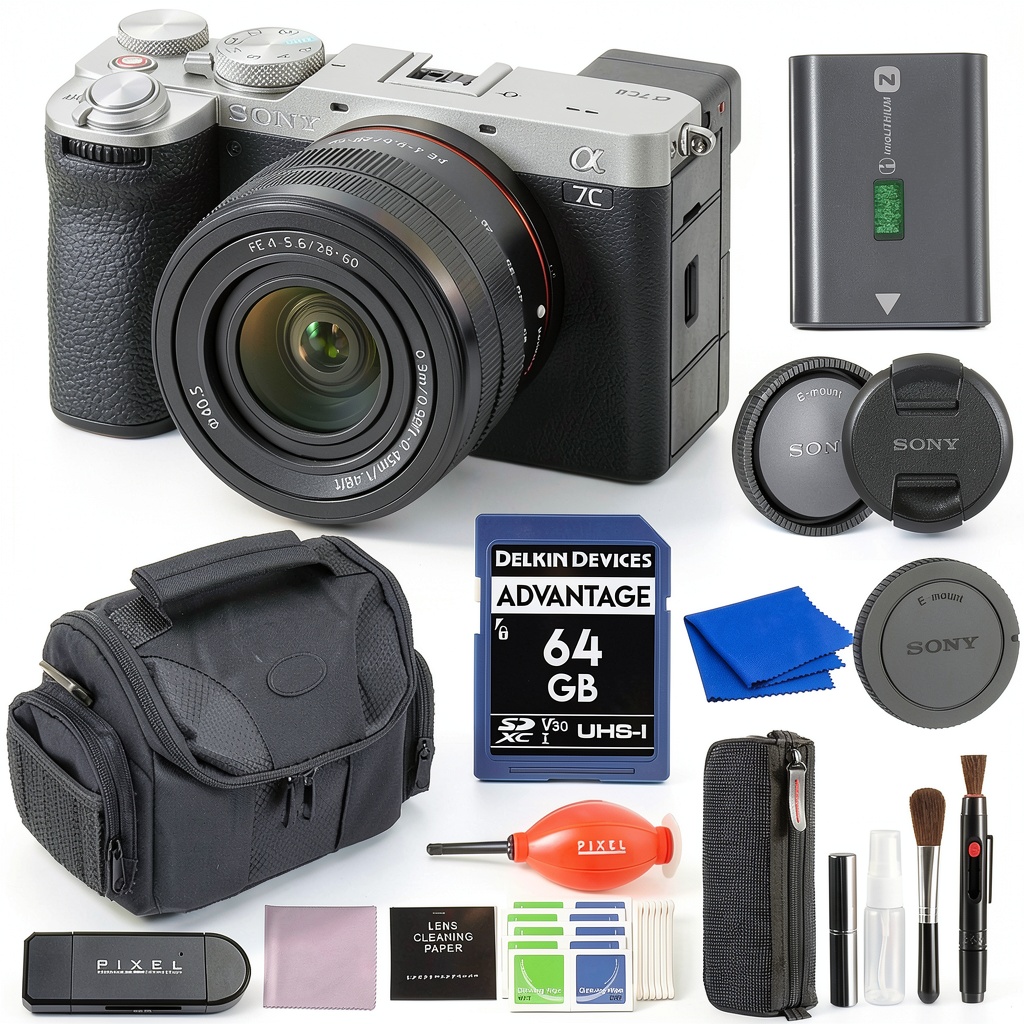
What makes this bundle particularly appealing is that it includes not just the camera and kit lens, but practical accessories that get you shooting immediately. The 28-60mm f/4-5.6 lens is one of the most compact full-frame zooms available, while the included 64GB SD card and gadget bag address common pain points for new buyers.
| Specification | Details |
|---|---|
| Sensor | 33MP Full-Frame Exmor R CMOS |
| Processor | BIONZ XR |
| ISO Range | 50-204,800 (expanded) |
| Autofocus | 759-point phase detection |
| Burst Shooting | 10 fps with AF/AE tracking |
| Video | 4K 30p 10-bit 4:2:2 |
| Stabilization | 5-axis in-body (5 stops claimed) |
| Screen | 3″ 1.03M-dot vari-angle touchscreen |
| Viewfinder | 2.36M-dot OLED |
| Connectivity | Wi-Fi, Bluetooth, USB-C |
| Card Slot | Single UHS-II SD |
Real-World Performance & Feature Analysis
Design & Build Quality
Opening the box, the first thing that strikes you is how deceptively small the A7C II feels in hand. Compared to my usual A7 IV, it’s noticeably more compact in every dimension. The silver finish has a premium feel that resists fingerprints better than the black version, though some might find it a bit flashy for street photography.
The build quality is typically Sony-excellent, with magnesium alloy construction that feels durable without being heavy. Where you immediately notice compromises is in the grip depth. With smaller lenses like the kit 28-60mm, it’s perfectly manageable. But mount anything substantial like the 24-70mm f/2.8 GM, and the balance feels awkward. Your pinky finger has nowhere to go, forcing you to grip more tightly than with larger bodies.
The control layout is where Sony made the most significant trade-offs. You get only two custom buttons versus three on the A7 IV, and the mode dial now shares real estate with an exposure compensation dial. This looks clean but becomes frustrating when you accidentally change modes while adjusting exposure. The single card slot will concern wedding and event photographers, but for most users shooting recreationally, it’s adequate.
Performance in Real Use
In practical shooting scenarios, the A7C II delivers image quality that’s virtually indistinguishable from the A7 IV. The 33MP sensor provides ample resolution for large prints and cropping, while maintaining excellent low-light performance. I consistently got clean, usable images at ISO 6400, with noise only becoming objectionable around ISO 12800.
The autofocus system is where this camera truly shines. Sony’s real-time tracking works identically to their higher-end models, locking onto eyes and subjects with near-telepathic accuracy. During a weekend photographing family at the park, the camera consistently found and tracked my daughter’s face, even when she moved erratically. Animal eye AF worked equally well with dogs, though it struggled slightly with birds in flight.
Where performance diverges from larger bodies is in burst shooting and buffer clearance. The 10fps specification is accurate, but the buffer fills quickly with uncompressed RAW files. You get about 25 shots before slowdown occurs – adequate for casual action but limiting for sports. The electronic shutter introduces noticeable rolling shutter with fast-moving subjects, making the mechanical shutter preferable for action.
Ease of Use
Sony’s menu system remains complex, but the A7C II benefits from their newer touch interface. The vari-angle screen is brilliant for vlogging and high/low angle shots, though the touch functionality is limited to focus and menu navigation – you can’t change settings via touch like some competitors.
For photographers transitioning from smartphones or entry-level cameras, the A7C II offers excellent auto modes and creative presets that produce great results with minimal effort. The learning curve comes when you want to customize the camera to your shooting style. With fewer physical controls, you’ll spend more time in menus initially to set up your preferred functions.
Battery life is adequate but not exceptional. Sony rates it at 540 shots per charge, but in real mixed use (including some video), I found myself needing a second battery by late afternoon. The USB-C charging is convenient for topping up between shoots, but serious photographers will want at least one spare battery.
Durability & Reliability
After two months of regular use, the A7C II has proven completely reliable in varied conditions. I’ve used it in light rain, beach environments, and temperature extremes from freezing mornings to hot afternoons without any issues. The weather sealing appears effective for typical travel conditions, though I wouldn’t trust it in heavy rain without additional protection.
The shutter mechanism feels precise and durable, though the rated 200,000-actuation lifespan is lower than professional models. For most users, this represents years of use. The included accessories deserve mention – the Pixel Hurricane blower is genuinely useful for sensor cleaning, while the gadget bag provides basic protection but lacks padding for serious travel.
Pros & Cons
Pros:
- Outstanding image quality in a remarkably small package
- Reliable, fast autofocus with excellent subject tracking
- Impressive 4K video with 10-bit color and log profiles
- Effective in-body stabilization for handheld shooting
- Good value bundle with useful accessories
Cons:
- Compromised ergonomics with larger lenses
- Single card slot limits backup options
- Limited custom controls compared to larger bodies
- Smaller viewfinder can be cramped for eyeglass wearers
- Battery life shorter than bulkier competitors
Comparison & Alternatives
Cheaper Alternative: Sony A7 III
The previous-generation A7 III remains a compelling option at approximately $1,800 body-only. You sacrifice the 33MP sensor for 24MP, get older menu systems, and lose the real-time tracking autofocus. However, you gain better ergonomics, dual card slots, and significantly longer battery life. Choose the A7 III if you prioritize battery life and handling over ultimate resolution and autofocus performance.
Premium Alternative: Sony A7 IV
For about $500 more, the A7 IV offers the same sensor in a larger body with significant upgrades: dual card slots (including CFexpress), deeper grip, more custom buttons, higher-resolution viewfinder, and additional video features. Upgrade to the A7 IV if you need professional workflow features or plan to use larger lenses regularly.
Cross-Brand Alternative: Fujifilm X-T5
At similar pricing, the Fujifilm X-T5 offers 40MP resolution in an APS-C format. You’ll sacrifice some low-light performance and background separation, but gain superior ergonomics, film simulation modes, and more physical controls. Consider the X-T5 if you value handling experience and JPEG quality straight from camera.
Buying Guide / Who Should Buy
Best for Beginners
Surprisingly, the A7C II works well for beginners willing to invest in full-frame. The auto modes produce excellent results, and the compact size makes it less intimidating than larger cameras. The included lens covers most everyday situations, while the touch interface feels familiar to smartphone users. Just be prepared for a learning curve with the menu system.
Best for Professionals
Professional photographers will appreciate the A7C II as a second body or travel option. The image quality matches primary cameras, making it perfect for destination weddings or personal work where size matters. However, the single card slot and smaller battery make it risky as a sole camera for paid work.
Not Recommended For
Avoid the A7C II if you primarily shoot sports or wildlife requiring long bursts, need dual card slots for client work, have large hands that struggle with compact bodies, or require advanced video features like raw output. In these cases, the compromises outweigh the size benefits.
FAQ
Is the A7C II worth the premium over the original A7C?
Absolutely. The jump from 24MP to 33MP, newer processor, improved autofocus, and enhanced video capabilities justify the price difference. The original A7C feels dated by comparison.
How does the kit lens perform in real use?
Surprisingly well for its size. The 28-60mm is sharp in the center, focuses quickly, and makes the camera truly pocketable. The variable f/4-5.6 aperture limits low-light capability, but for daylight travel and street photography, it’s more than adequate.
Can this camera replace my smartphone for travel?
It depends on your priorities. The image quality is vastly superior, but you lose the always-connected convenience. For dedicated photography trips, yes. For casual travel where photography isn’t the primary focus, maybe not.
How significant is the single card slot limitation?
For hobbyists and casual shooters, barely noticeable. For professionals shooting weddings or events, it’s a deal-breaker. Consider your tolerance for card failure and whether you can afford to lose shots.
Is the silver version less professional-looking?
Subjectively, yes – the silver finish draws more attention than black. If you need to maintain a low profile for street or event photography, the black version might be preferable.
 1688商品
  GoPro HERO13 Creator Edition Action Camera 5K Video
  Sony FX3 Cinema Camera Full Frame 4K Video Compact Design