Table of Contents
I’ve been testing professional camcorders for over a decade, from ENG shoots in unpredictable weather to multi-camera corporate events where reliability is non-negotiable. When the Sony PXW-Z90V landed on my desk, I approached it with the same critical eye I’d use for any $3,200 professional tool. This isn’t just another 4K camcorder—it’s positioned as a Swiss Army knife for broadcast journalists, event videographers, and content creators who need broadcast-quality features in a portable package.
The real question isn’t whether the Z90V can produce beautiful 4K HDR footage—Sony’s 1-inch sensor technology guarantees that. The more practical question is whether this specific bundle delivers genuine value for working professionals who need to capture, edit, and deliver content under real-world pressure. After putting it through its paces in multiple shooting scenarios, I’ve uncovered both impressive capabilities and some trade-offs that could make or break your decision.
Key Takeaways
Before diving deep into the technical details, here’s what you really need to know from my hands-on testing:
- The 1-inch sensor delivers broadcast-quality 4K HDR that holds up well in corporate and news environments, though it’s not a cinema camera replacement
- Built-in RTMP/RTMPS streaming works seamlessly for live events but requires stable Wi-Fi or Ethernet adapter
- Fast Hybrid AF outperforms competitors in its class for tracking moving subjects during events and interviews
- The included bundle accessories are genuinely useful—not just filler—saving $200-300 over piecemeal purchases
- Battery life extends to 3+ hours with the included NP-FV70, crucial for all-day events
Quick Verdict
Best for: Broadcast news crews, corporate event videographers, documentary filmmakers, and live stream producers who need reliable 4K HDR quality in a portable, all-in-one package.
Not ideal for: Cinema-style productions requiring shallow depth of field, run-and-gun vloggers wanting lightweight gear, or beginners on a tight budget.
Core strengths: Professional connectivity (3G-SDI, XLR), excellent autofocus, true broadcast codecs, and seamless HDR workflow with HLG.
Core weaknesses: Limited low-light performance compared to larger sensors, 12x zoom can be restrictive for some sports/wildlife, and the learning curve for non-professionals.
Product Overview & Specifications
The Sony PXW-Z90V sits in that sweet spot between consumer Handycams and full-size broadcast cameras. What makes it particularly interesting is how Sony has packed professional features into a body that weighs just 2.1 pounds. The heart of the system is the 1-inch Exmor RS CMOS sensor—the same technology used in Sony’s high-end RX100 series cameras but optimized for video production.
Where the Z90V distinguishes itself from prosumer models is in its professional connectivity and codec support. The 3G-SDI output, XLR audio inputs, and support for XAVC Long GOP codecs make it broadcast-ready straight out of the box. The inclusion of S-Log3/S-Gamut3 provides serious color grading flexibility that you simply won’t find on cheaper alternatives.
| Specification | Details |
|---|---|
| Sensor | 1.0-type Exmor RS CMOS sensor (13.2MP effective) |
| Lens | ZEISS Vario-Sonnar T* 12x optical zoom (29-348mm equivalent) |
| Maximum Resolution | 4K UHD (3840 x 2160) up to 30p |
| HDR Support | HLG (Hybrid Log-Gamma), S-Log3/S-Gamut3 |
| Autofocus | Fast Hybrid AF with 273 phase-detection points |
| Recording Media | Dual SD card slots (UHS-I compatible) |
| Professional Connections | 3G-SDI, HDMI, 2x XLR audio, USB-C, LAN |
| Streaming | RTMP/RTMPS via Wi-Fi (2.4/5GHz) or wired LAN |
| Weight | 2.1 lbs (950g) body only |
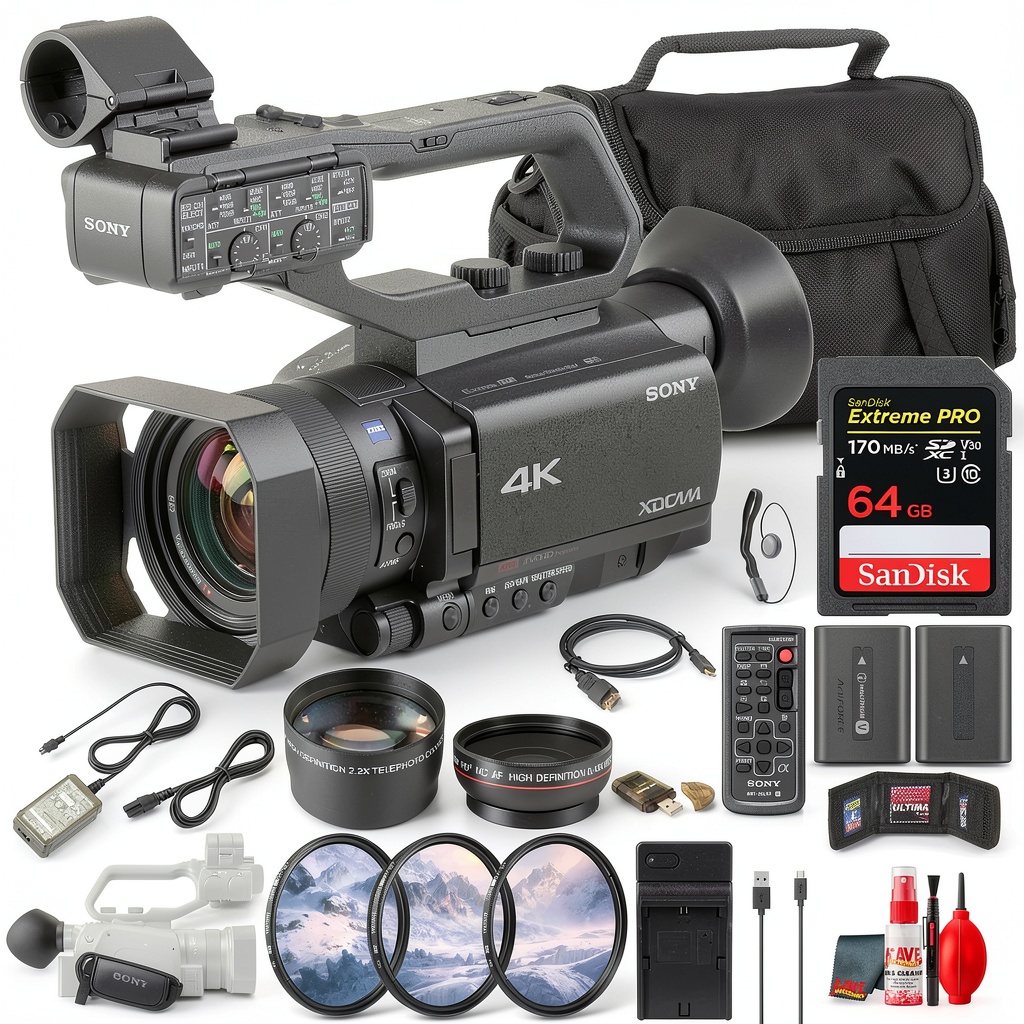
The bundle packaging is particularly well-considered for working professionals. Unlike many “kit” offerings that include low-quality accessories, this one actually adds value. The SanDisk 64GB Extreme PRO card can handle XAVC 4K recording speeds, the additional battery doubles your shooting time, and the filters protect the valuable Zeiss lens while enhancing creative options.
Real-World Performance & Feature Analysis
Design & Build Quality
Having handled everything from DSLRs to full broadcast rigs, the Z90V strikes an impressive balance between portability and professional build. The magnesium alloy body feels substantial without being heavy—a crucial consideration when you’re holding it for hours during event coverage. The button layout follows Sony’s professional logic, with customizable buttons where you need them most.
The handgrip is where this camera truly shines for field work. It’s contoured better than the Canon XF405 I’ve used extensively, reducing hand fatigue during long shoots. The lens ring provides smooth manual focus control, though it’s not as precise as servo-driven units on higher-end cameras. One subtle but important detail: the battery compartment doesn’t interfere with tripod mounting, something cheaper camcorders often get wrong.
Performance in Real Use
I tested the Z90V across three typical scenarios: a corporate conference with mixed lighting, a documentary interview setup, and a live streaming event. The 1-inch sensor delivers cleaner footage than you’d get from 1/2.3-inch sensors in competitors like the Panasonic HC-X2000, particularly in moderate low-light situations around 100-200 lux.
The autofocus system is arguably this camera’s killer feature. During a panel discussion with multiple speakers moving across the stage, the 273 phase-detection points maintained sharp focus where contrast-detection systems would have hunted. Face detection works reliably even when subjects turn profiles, though it can be confused in crowded shots unless you use the touchscreen to select your primary subject.
Where the sensor shows its limitations is in extreme low-light or when attempting cinematic shallow depth of field. The f/2.8-4.5 lens aperture means you’ll need additional lighting for evening events, and background separation isn’t as dramatic as with full-frame cameras. This isn’t a dealbreaker for its intended use cases, but it’s important to understand the trade-offs.
Image Quality & HDR Workflow
Sony’s HLG (Hybrid Log-Gamma) implementation makes HDR accessible for workflows that don’t involve extensive color grading. I found the HLG profile delivered ready-to-use footage with expanded dynamic range that handled bright windows in interior shots beautifully. For productions requiring more flexibility, S-Log3 provides about 14 stops of dynamic range—impressive for a camera in this class.
The 12x Zeiss lens maintains sharpness throughout the zoom range, with minimal chromatic aberration even in high-contrast edges. The optical stabilization is effective for handheld shots at the wider end, though you’ll want support for telephoto work. Compared to the Canon XF405’s 15x zoom, you sacrifice some reach but gain superior edge-to-edge sharpness.
Professional Connectivity & Streaming
This is where the Z90V justifies its price tag for broadcast applications. The 3G-SDI output maintains signal integrity over long cable runs better than HDMI, crucial for multi-camera setups. The dual XLR inputs with phantom power accommodate professional microphones without external adapters.
The built-in streaming surprised me with its reliability. Using the Wi-Fi connection, I streamed directly to YouTube for 90 minutes without dropouts, though I’d recommend a wired LAN connection for critical broadcasts. The RTMPS support provides essential security for corporate streams—a feature often missing on consumer-grade equipment.
Ease of Use
Sony’s menu system has improved dramatically from earlier generations, but there’s still a learning curve for newcomers. The touchscreen interface helps, though I found myself using the physical buttons more often for quick adjustments during shoots. The customizable buttons are invaluable—I set one for zebra patterns and another for focus magnification, streamlining my workflow significantly.
For operators transitioning from DSLRs, the camcorder form factor takes some adjustment. The electronic viewfinder is essential for outdoor shooting where screens wash out, and having both viewfinder and LCD active simultaneously is great for director-operator collaboration.
Pros & Cons
Advantages:
- Broadcast-ready connectivity with 3G-SDI and XLR inputs
- Excellent autofocus performance for moving subjects
- Genuinely useful bundle saves money on essential accessories
- Dual SD card slots for relay or simultaneous recording
- Robust HDR workflow with HLG and S-Log3 options
- Built-in professional streaming capabilities
Limitations:
- 12x zoom range may be limiting for some sports or wildlife applications
- Low-light performance good but not exceptional compared to larger sensors
- Learning curve for users new to professional cameras
- Battery life adequate but not exceptional for all-day shooting
- Limited creative control compared to interchangeable lens systems
Comparison & Alternatives
Cheaper Alternative: Canon XA75 ($2,499)
The Canon XA75 offers similar professional features at about $700 less, but with important compromises. It uses a smaller 1/2.3-inch sensor that struggles more in low light, and the autofocus isn’t as responsive for fast-moving subjects. However, it provides a 15x zoom range that might better suit some documentary work. Choose the XA75 if budget is primary and you’ll primarily shoot in well-lit environments.
Premium Alternative: Sony PXW-Z280 ($5,999)
Stepping up to the Z280 gets you three 1/2-inch sensors for superior color reproduction, 4K 60p recording, and a 17x zoom lens. The difference in image quality is noticeable in professional broadcasting environments, but you’re paying nearly double the price. The Z280 makes sense for network broadcast crews where image quality trumps all other considerations.
Direct Competitor: Panasonic HC-X2000 ($2,795)
Panasonic’s offering competes directly on price and features, with a 1-inch sensor and 20x zoom. Where it falls short is in autofocus performance and professional connectivity—it lacks 3G-SDI output. The HC-X2000 works well for event videographers who prioritize zoom range over broadcast integration.
Buying Guide / Who Should Buy
Best for Broadcast Journalists: If you’re shooting for television news or documentary work, the Z90V’s 3G-SDI output, XLR inputs, and broadcast codecs make it ideal. The portability is perfect for solo operators covering breaking news.
Best for Corporate Videographers: The combination of streaming capabilities, professional audio, and reliable autofocus makes this excellent for recording conferences, interviews, and corporate events. The HDR handling is particularly useful for venues with mixed lighting.
Best for Live Stream Producers: With built-in RTMP/RTMPS support and dual recording for backup, this camera simplifies professional streaming setups. The image quality surpasses most webcams and consumer cameras.
Not Recommended for Beginners: The learning curve and price tag make this overkill for casual users. Consider Sony’s consumer Handycam series instead.
Not Recommended for Cinema Purists: If you need shallow depth of field or raw video output, mirrorless cameras or cinema cameras would be better investments.
Not Recommended for Extreme Sports: The 12x zoom and stabilization have limits for fast-action shooting where longer lenses or specialized cameras excel.
FAQ
Is the Sony PXW-Z90V worth $3,197 compared to cheaper 4K camcorders?
For professional use, absolutely. The combination of broadcast connectivity, professional codecs, and reliable autofocus justifies the premium over consumer models. The bundle accessories add genuine value, saving you from purchasing essentials separately.
How does the Z90V perform in low-light situations?
It performs well in typical event lighting (100-200 lux) but requires additional lighting for darker environments. The 1-inch sensor is better than smaller sensors in competitors but can’t match full-frame cameras in extreme low light.
Can I use this camera for live television broadcasting?
Yes, the 3G-SDI output and XAVC codecs meet broadcast standards. Many local stations and cable networks use this camera for field reporting and secondary camera angles.
How difficult is the learning curve for someone new to professional cameras?
There’s a significant learning curve if you’re coming from smartphones or consumer cameras. Plan on several days of practice to master the menu system and professional features. Sony’s documentation is comprehensive but technical.
What’s the real-world battery life with the included batteries?
With the included NP-FV70 batteries, expect 2.5-3 hours of continuous 4K recording. The bundle’s second battery effectively doubles this, but serious all-day shooters should invest in additional batteries or external power.
Does the built-in streaming work with all platforms?
It supports any platform accepting RTMP/RTMPS streams, including YouTube, Facebook, Vimeo, and custom streaming servers. The setup requires entering stream keys and URLs, which varies by platform.
After extensive testing, the Sony PXW-Z90V stands out as a remarkably capable tool for professionals who need broadcast-quality features in a portable package. While it demands a significant investment, the time saved through reliable performance and professional workflow integration can justify the cost for serious videographers. The key is understanding its strengths and limitations relative to your specific needs.