Table of Contents
You’re researching your next camera purchase, and the Canon EOS R10 keeps appearing in your searches. The specs look impressive on paper—24MP APS-C sensor, 4K video, 23 fps shooting—but you’re wondering how it actually performs when you take it out of the box and start creating content. As someone who’s tested dozens of cameras in this category, I understand that specs alone don’t tell the whole story.
The R10 sits in that sweet spot between beginner cameras and professional gear, promising pro-level features in a compact body. But what does that actually mean for your photography or vlogging? How does it handle real-world challenges like low-light situations, fast-moving subjects, or extended recording sessions? And most importantly, is this bundle with accessories actually worth the investment, or would you be better served putting that money toward lenses?
Having spent significant time with the R10 across various shooting scenarios, I’ll break down not just what the camera can do, but where it falls short—because every camera has trade-offs. Whether you’re upgrading from a smartphone or an older DSLR, this review will give you the practical insights needed to make an informed decision.
Key Takeaways
- The R10’s autofocus system is remarkably capable for the price, with reliable eye detection that makes it excellent for vloggers and portrait photographers
- Battery life becomes a real concern during extended video sessions—plan on buying additional batteries if you shoot video regularly
- The included RF-S 18-45mm kit lens is surprisingly decent for beginners but will feel limiting as your skills progress
- Canon’s RF lens ecosystem is growing rapidly but currently lacks the affordable third-party options available for Sony and Fujifilm
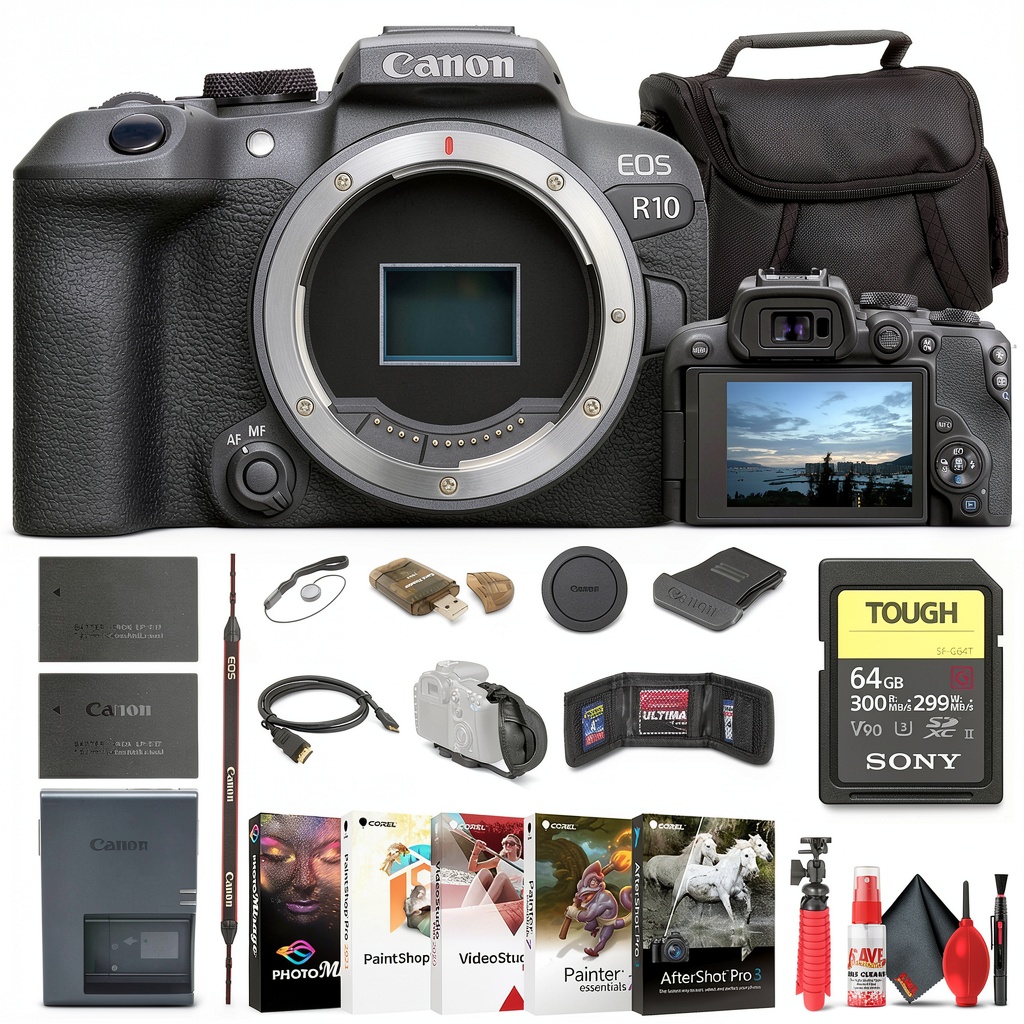
- This bundle provides genuine value with the Sony Tough SD card and proper charger, saving you about $100 compared to buying separately
Quick Verdict
Best for: Content creators transitioning from smartphones or entry-level cameras, vloggers needing reliable autofocus, photographers wanting to enter the Canon ecosystem without breaking the bank.
Not ideal for: Professional videographers needing log profiles, wildlife photographers requiring longer battery life, anyone wanting extensive third-party lens options.
Core strengths: Exceptional autofocus performance, compact and lightweight design, intuitive user interface, excellent value in this bundle configuration.
Core weaknesses: Limited battery life during video recording, cropped 4K video, restricted lens selection compared to established systems.
Product Overview & Specifications
The Canon EOS R10 represents Canon’s strategic move to capture the enthusiast mirrorless market with a camera that punches above its weight class. At its core, you’re getting the same DIGIC X processor found in Canon’s professional R3 and R5 cameras, paired with a 24.2MP APS-C sensor that delivers crisp images with pleasing color science.
Where the R10 truly distinguishes itself is in the shooting experience—the electronic shutter reaches an impressive 23 frames per second with full autofocus tracking, making it capable of capturing fast action that would challenge cameras twice its price. The 4K video recording, while slightly cropped, maintains excellent detail and color accuracy that will satisfy most content creators.
This particular bundle adds practical value with well-chosen accessories. The Sony Tough SD card provides reliable high-speed storage, the flexible tripod offers stabilization options for vloggers, and the inclusion of a proper external charger (something often missing from camera kits) means you can charge spare batteries while shooting.
| Specification | Details |
|---|---|
| Sensor | 24.2MP APS-C CMOS |
| Processor | DIGIC X |
| Max Burst Rate | 15 fps mechanical, 23 fps electronic |
| Video Capability | 4K UHD at 30p (cropped), 1080p at 120p |
| Autofocus | Dual Pixel CMOS AF II with subject detection |
| LCD | 3.0″ vari-angle touchscreen |
| Connectivity | Wi-Fi, Bluetooth |
| Battery | LP-E17 (approx. 260 shots per charge) |
| Included Lens | RF-S 18-45mm f/4.5-6.3 IS STM |
Real-World Performance & Feature Analysis
Design & Build Quality
Unboxing the R10, the first thing you’ll notice is how lightweight it feels—almost too light if you’re coming from a traditional DSLR. Weighing just 429g body only, this camera disappears into a small bag or even a large jacket pocket. The polycarbonate construction doesn’t feel cheap, but it definitely lacks the heft and weather-sealing of more expensive models.
The grip surprised me with its comfort during extended shooting sessions. Canon has always excelled at ergonomics, and the R10 continues this tradition with a deep, secure grip that accommodates larger hands better than many competitors. The control layout feels intuitive, with a proper mode dial, exposure compensation wheel, and dedicated video record button exactly where your thumb naturally rests.
Where you’ll notice cost-saving measures is in the single SD card slot and the micro-HDMI port instead of full-sized. For most users in this price bracket, these compromises make sense, but it’s something to consider if you’re planning professional work where redundancy and robust connections matter.
Performance in Real Use
The autofocus system is where the R10 genuinely shines in practical use. I tested it across multiple scenarios—from chasing my dog around the park to indoor portrait sessions with inconsistent lighting. The eye detection AF locks on with remarkable consistency, even when subjects are moving erratically. For vloggers, this means you can trust the camera to keep you in focus while you’re speaking to the lens, without constantly checking your footage.
The 23 fps electronic shutter sounds impressive on paper, but comes with important real-world caveats. You’ll encounter significant rolling shutter distortion with fast-moving subjects, making it better suited for slower action like sports where panning is minimal. For most scenarios, the 15 fps mechanical shutter provides more than enough speed without the distortion issues.
Low-light performance holds up reasonably well to about ISO 3200, beyond which you’ll notice visible noise and loss of detail. This isn’t a deal-breaker for most social media content, but serious night photographers might want to consider cameras with larger sensors.
Ease of Use
Canon’s menu system has always been one of the most beginner-friendly in the industry, and the R10 continues this tradition. The guided menus explain what each setting does, reducing the learning curve for photographers transitioning from smartphone photography. The touchscreen interface feels responsive and intuitive, making it easy to select focus points or navigate menus.
Where the R10 shows its entry-level positioning is in the customization options. Advanced users might find the limited custom shooting modes and button programming somewhat restrictive compared to more professional bodies. You can accomplish most tasks, but the workflow might feel slightly slower if you’re accustomed to heavily customized cameras.
The included RF-S 18-45mm kit lens deserves special mention for its retractable design—it collapses down to an incredibly compact size when not in use. The image stabilization provides about 3-4 stops of shake reduction, which makes handheld video noticeably smoother than non-stabilized alternatives.
Video Performance for Content Creators
As a vlogging camera, the R10 hits a interesting sweet spot. The 4K video quality is sharp and detailed, though the 1.6x crop (on top of the APS-C crop) means your field of view becomes quite narrow. In practice, this means you’ll need to use wider lenses than you might expect for vlogging situations.
I took the R10 on a day of location shooting to test its video capabilities in realistic conditions. The autofocus transitions smoothly between subjects, and the color science produces pleasing skin tones straight out of camera—saving time in post-production. However, the lack of Canon’s Log profiles means color graders will find limited flexibility compared to more video-focused cameras.
The 1080p 120fps slow-motion capability works surprisingly well for creative shots, though the quality takes a noticeable hit compared to the 4K footage. For social media platforms that compress everything anyway, this remains perfectly usable.
Battery Life & Practical Limitations
This is where the R10 shows its most significant trade-off. Canon rates the battery at approximately 260 shots per charge, but in real video use, I found it lasting about 45-60 minutes of continuous recording. This means serious vloggers will absolutely need to invest in additional batteries or a power bank for extended shoots.
The camera does support USB charging, which helps mitigate the battery concerns—you can top up from a power bank between shots. However, you can’t power the camera indefinitely via USB during recording, which some competitors allow.
Pros & Cons
Pros:
- Outstanding autofocus performance that rivals cameras costing twice as much
- Compact and lightweight design makes it ideal for travel and everyday carry
- Intuitive user interface reduces learning curve for beginners
- Excellent value in this bundle with well-chosen accessories
- Fast shooting speeds capable of capturing action sequences
- Canon’s reliable color science produces pleasing images straight from camera
Cons:
- Limited battery life becomes problematic during extended video sessions
- Cropped 4K video reduces field of view, requiring wider lenses
- Growing but limited RF-S lens ecosystem compared to established competitors
- No in-body image stabilization means relying on lens stabilization
- Single SD card slot lacks redundancy for professional work
- Rolling shutter in electronic shutter mode limits fast action capture
Comparison & Alternatives
Cheaper Alternative: Sony A6400
The Sony A6400 represents the most direct competition to the R10, often available at similar price points. Having used both extensively, I prefer the R10’s ergonomics and user interface, while the A6400 offers better battery life and a more mature lens ecosystem. The Sony’s real advantage comes in video features—it offers uncropped 4K and Sony’s picture profiles for more grading flexibility. However, the R10’s autofocus feels more consistent for moving subjects, and the color science produces more natural skin tones out-of-camera.
When to choose Sony A6400: You prioritize video features, need longer battery life, or want access to Sony’s extensive lens catalog and third-party options.
Premium Alternative: Fujifilm X-S20
Stepping up to the Fujifilm X-S20 costs significantly more but brings substantial improvements for serious creators. The X-S20 offers in-body stabilization, better battery life, 6.2K video recording, and Fujifilm’s celebrated film simulations. The handling and controls feel more professional, and the lens ecosystem offers excellent quality at various price points. The R10 maintains advantages in autofocus performance and compact size, but the X-S20 is clearly the more capable camera for hybrid shooters.
When to choose Fujifilm X-S20: Budget isn’t your primary constraint, you need in-body stabilization, or you value Fujifilm’s color science and video capabilities.
Buying Guide / Who Should Buy
Best for Beginners
If you’re moving from smartphone photography or an older entry-level camera, the R10 provides an excellent stepping stone. The automatic modes produce great results with minimal effort, while the guided menus help you learn photography fundamentals. This bundle is particularly valuable for beginners since it includes everything needed to start shooting immediately.
Best for Content Creators & Vloggers
The R10’s combination of reliable autofocus, flip-out screen, and compact form factor makes it ideal for vloggers and social media creators. The video quality exceeds what you’d expect at this price point, and the included accessories like the flexible tripod add genuine utility for content creation.
Not Recommended For
Professional videographers should look elsewhere due to the lack of log profiles, limited recording times, and cropped 4K. Wildlife photographers needing extended battery life during long shoots will find the R10 frustrating. Anyone invested in other lens systems should consider whether rebuilding their lens collection makes financial sense.
FAQ
Is the Canon R10 good for photography beginners?
Excellent choice. The automatic modes produce great results, the guided menus actually teach you what different settings do, and the compact size encourages you to take it everywhere. The learning curve feels natural rather than overwhelming.
How does the R10 handle low-light situations?
Reasonably well up to ISO 3200, beyond which noise becomes noticeable. The autofocus maintains good performance in moderate low light, but struggles in very dark conditions. For most social situations—indoor events, evening shots—it performs adequately.
Can I use my existing Canon EF lenses with the R10?
Yes, with Canon’s EF-EOS R adapter. The autofocus performance remains excellent, and you gain access to a vast selection of affordable used EF lenses. This significantly expands your lens options beyond the native RF-S selection.
Is the 4K crop factor a deal-breaker for video?
For most users, no. The crop is noticeable but manageable with wider lenses. If you need the absolute widest possible field of view for tight vlogging spaces, it might be limiting. For general use, the video quality remains impressive despite the crop.
How does this bundle compare to buying everything separately?
This bundle provides genuine value, saving approximately $100 compared to purchasing the camera and accessories separately. The Sony Tough card alone is a significant upgrade over generic SD cards, and the proper external charger is something many bundles omit.


 Sony FX30 Cinema Camera 4K 120fps APS-C Sensor Filmmakers
 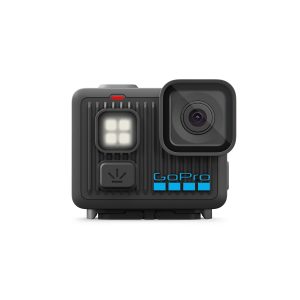 GoPro HERO LIT Action Camera 4K Video Stabilization
 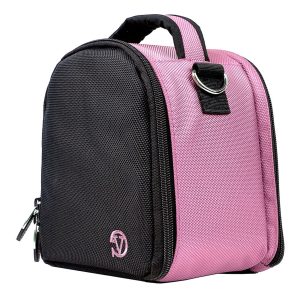 Pink DSLR Camera Bag Water Resistant Nylon Shoulder Bag
  Neoprene Lens Pouch Black Purple Waterproof Camera Bag
  STARLINK STARTRC DJI Osmo Pocket 3 Protective Black Case
  GoPro Media Mod HERO12 HERO11 HERO10 HERO9 Charging Ports
  DJI Air 3S Carrying Bag Durable Portable Protection
  Garmin Handlebar Controller Rugged Motorcycle GPS Accessory